
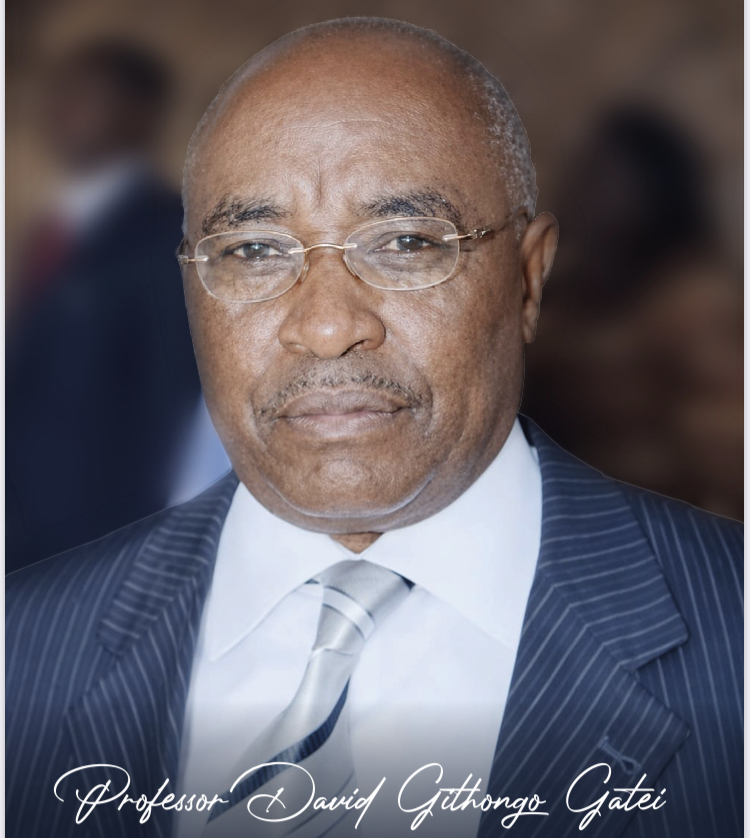
Prof David Gatei (DG)
It is with deep sorrow that we announce the passing of Prof David Githongo Gatei who passed on 20th March 2026. Prof Gatei (DG) was a prominent Professor at the Department of Human Pathology. He was a part of the early and foundational academic leadership in UON’s medical school and helped build capacity in diagnostic pathology and laboratory medicine in Kenya.
A TRIBUTE TO PROF. GATEI.
It is both an honor and a deeply humbling privilege to pay tribute to a remarkable man—DG, as we fondly called him: a professor, teacher, mentor, and role model whose legacy is indelibly etched in the history of medicine in Kenya.
He belonged to a pioneering generation and was among the first African Professors of pathology in this country. From his early training at Makerere University College to his attainment of his FRCPath in Glasgow, his journey was not merely one of personal excellence but also of opening doors and setting standards for those who would follow. He was, in every sense, a trailblazer.
As a young faculty member at the University of Nairobi Medical School, he rose steadily through the academic ranks to Associate professorship. Alongside his peers, he helped build what would become a formidable school of medicine—nurturing not just institutions, but generations of clinicians and scientists. His contributions to medical education were profound, and his role in establishing the MMed Pathology program in the late 1980s remains a cornerstone of specialist training in this country.
His service extended well beyond lecture halls and laboratories. He gave of himself generously to national duty, serving on multiple boards, including the Medical Board, and as Chairman of ICDC—always guided by principle, discipline, and a deep sense of responsibility.
But it is perhaps in the classroom and at the microscope that many of us came to know him best. He was indefatigable in the teaching of anatomic pathology—demanding, exacting, and unwavering in his expectations. He insisted on punctuality, precision in thought and language, and absolute accuracy in surgical and autopsy reports. Sloppiness, tardiness, and incomplete work had no place under his watch. He stood firmly for truth, and he expected the same of all of us.
Many who trained under him will never forget his oft-repeated counsel:
“Always stand on the right side of truth, and history will judge you kindly.”
It was more than advice—it was a creed by which he lived.
Yes, he could be strict—even abrasive at times—and many students knew only that formidable exterior. But those who knew him more closely also witnessed another side: a man capable of warmth, humor, and joy. He could laugh heartily, and in moments of celebration, he surprised us all—an elegant dancer, gliding through a waltz with a grace worthy of a king’s ballroom.
That was the fullness of the man—disciplined yet vibrant, exacting yet human, formidable yet deeply committed to shaping others.
His legacy lives on in the countless lives he touched—in lecture rooms, laboratories, hospital wards, and beyond. It lives on in the standards he set, the programs he built, and the generations he inspired to pursue excellence without compromise.
We remember him not only for what he achieved, but for what he demanded of us: integrity, rigor, and truth. May we continue to stand on the right side of that truth, and in doing so, honor his life and his legacy.
Fare thee well, DG—until we meet again.
Department of Human Pathology, University of Nairobi.
Click for more photos...
- Log in to post comments


